.png)
Why a Performance-Driven Mindset is Marketing’s Only Way Forward in the Age of AI
For years, the marketing industry fell into a comfortable rhythm. Teams were split into silos: brand purists focused on aesthetics and emotional resonance, while growth marketers lived in spreadsheet-optimization loops. Success was often measured in vanity metrics - impressions, likes, and theoretical reach.
Then, Artificial Intelligence arrived, tearing down the walls and rewriting the playbook.
Today, AI is no longer a futuristic buzzword or a novelty tool for drafting social copy. It has become the core operating system of modern marketing. The technology has democratized content creation, enabled hyper-personalized consumer data, and automated campaign distribution at a scale unimaginable just a few years ago.
But this shift introduces a massive challenge for brands. When anyone can deploy an AI workflow to generate content or launch an ad campaign in seconds, operational volume ceases to be a competitive advantage. To survive and scale, marketing functions must undergo a structural evolution. The only path forward is a relentless, performance-driven mindset that anchors creative AI execution to raw, bottom-line ROI.
1. The Demise of the "Software & Agency Trap"
Historically, businesses scaled their marketing by stacking software or hiring bloated agencies. The result? A fragmented tech stack where CRMs, email tools, and ad platforms don't talk to each other, and agencies send monthly reports filled with vague, feel-good metrics.
AI shatters this paradigm. Modern marketing functions are shifting away from fragmented tools toward unified, automated ecosystems. Instead of relying on human hands to manually move data, bridge tools, or write basic copy, AI engines can script, design, and schedule multi-channel distribution almost instantly.
Because execution has become automated, the role of the marketer must pivot from manager of tasks to architect of outcomes. The premium is no longer on the output itself, but on the measurable business performance that output generates.
2. Redefining Speed-to-Market as Speed-to-Lead
AI allows us to move fast, but a performance-driven mindset demands that we move fast where it actually impacts revenue. Consider lead acquisition. In the past, a marketing team might consider their job done once a user filled out a form. A traditional sales or follow-up sequence might take hours, if not days, resulting in cold leads and wasted ad spend.
In the AI era, performance marketing fuses lead generation with instant, multi-channel automation. The standard is now Instant Speed-to-Lead. AI workflows can engage an inbound lead via SMS, email, or direct message within 60 seconds of interaction.
[Inbound Lead Triggers] ➔ [AI Workflow Activates] ➔ [Multi-Channel Engagement within 60s] ➔ [Booked Appointment]
By connecting AI speed directly to lead-to-opportunity conversion rates, marketing shifts from a cost center to a predictable revenue generator.
3. From Vanity Metrics to True Unit Economics
When ad platforms utilize machine learning to handle the bulk of audience targeting, the true differentiator for brands becomes their internal performance metrics. A performance-driven mindset means discarding vanity metrics and obsessing over numbers that matter to a CFO:
Customer Acquisition Cost (CAC) Efficiency: Are AI tools lowering the cost of acquiring a customer, or just increasing ad noise?
Lifetime Value (LTV) Prediction: Using AI data models to target and retain high-value customer profiles rather than chasing low-intent clicks.
Database Monetization ("Dead List" Revival): Instead of paying massive monthly software taxes to let old customer databases sit idle, performance-driven marketing uses AI-segmented workflows to re-engage past data, turning cold lists into immediate cash flow.
4. The New Marketing Team: Leaner, Smarter, ROI-Focused
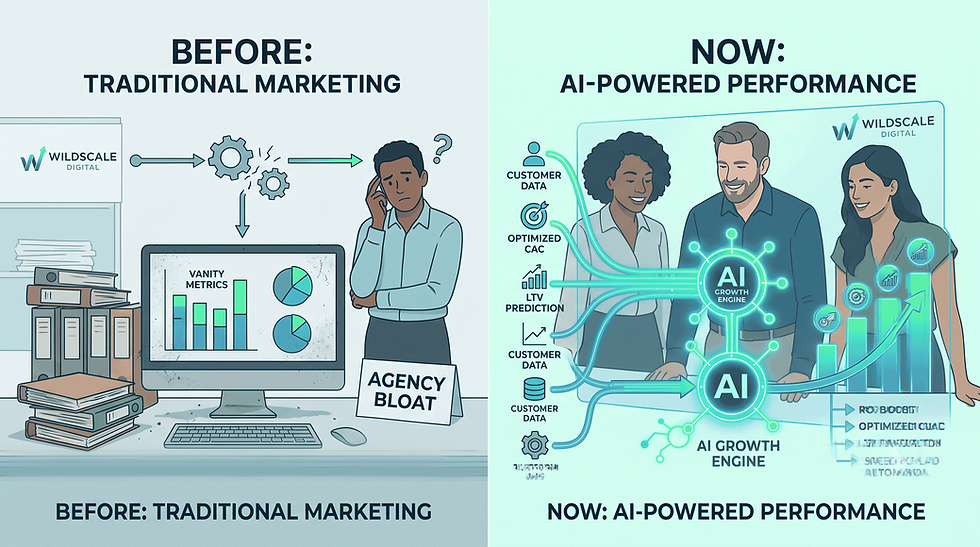
The evolution of marketing functions means the traditional agency bloat is dying. You no longer need a massive, disjointed team to maintain a dominant online presence. You need a smarter, hyper-efficient setup.
The future belongs to the fractional, automated growth expert. Marketers must become experts at prompting, building workflows, and parsing data insights. If an AI engine can handle the heavy lifting of daily scheduling and optimization, the human elements must focus entirely on strategy, offer architecture, deep customer empathy, and rigorous financial analysis.
The Way Forward
AI has leveled the playing field, making execution faster and cheaper than ever before. But speed without direction is just noise. For brands looking to scale effectively, the goal shouldn't be to just adopt more AI tools. The goal must be to build a hyper-efficient, data-backed growth engine where every automation, every creative asset, and every line of code is held accountable to a performance standard.
The future of marketing isn't just automated—it is ruthlessly performance-driven.
Comments