
Why the Whole Consumer Journey is the Secret to Effective Full-Funnel Marketing
For years, digital marketing operated in silos. Top-of-funnel teams blasted brand ads to generate awareness, middle-of-funnel teams pushed educational blogs and email captures, and bottom-of-funnel teams obsessively optimized ad retargeting to squeeze out conversions.
However, modern buyers do not interact with brands in a neat, linear line. A customer might discover your product on TikTok, research reviews on Reddit, open your website on desktop, abandon their cart, receive an email newsletter three weeks later, and finally purchase through a search ad.
Treating the marketing funnel as a rigid set of isolated steps leaves vast blind spots. Real effectiveness happens when you overlay the full consumer journey directly onto your full-funnel marketing strategy.
1. The Funnel is Your Blueprint; The Journey is the Experience
To understand why integrating both is critical, it helps to distinguish between the two frameworks:
The Marketing Funnel: The operational perspective. It tracks how a business moves potential buyers from discovery to purchase (Awareness - Consideration - Conversion).
The Consumer Journey: The human perspective. It documents the emotions, touchpoints, devices, and pain points a customer experiences across every interaction with your brand.
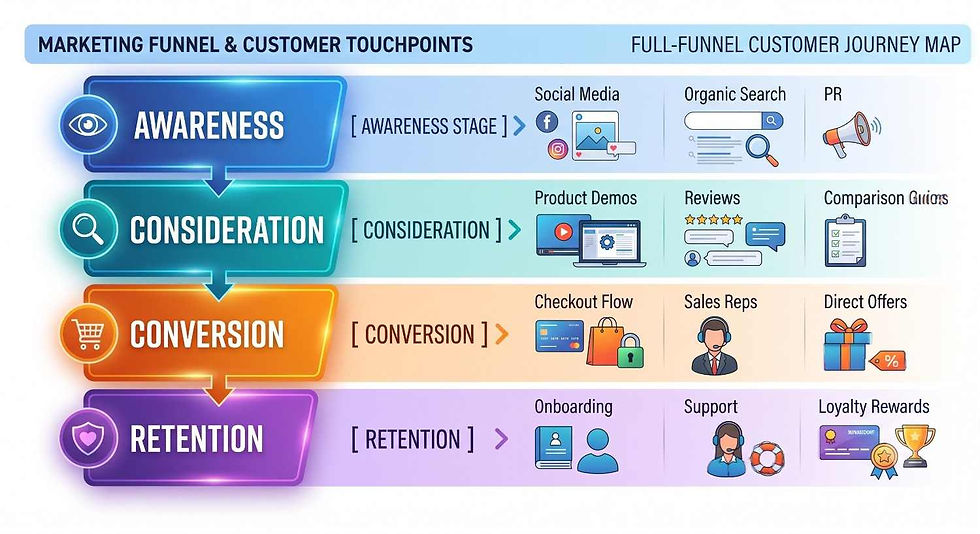
When you focus only on funnel metrics (e.g., click-through rates or cost-per-acquisition), you treat prospective buyers as numbers moving through a pipe. Mapping the consumer journey allows you to understand why customers drop off between stages, providing the context required to optimize campaign performance.
2. Eliminating Friction and Leaks Between Stages
A high bounce rate at the consideration stage rarely indicates an ineffective ad campaign; more often, it reveals a disconnect in the customer experience. If your top-of-funnel ads promise a seamless, innovative solution, but your middle-of-funnel landing page is confusing or lacks clear pricing details, prospects will drop off. By evaluating the whole journey, marketers can identify hidden friction points - such as broken mobile checkouts, slow-loading comparison pages, or aggressive sales outreach and fix the leaks in their funnel.
3. Creating Connected Messaging Across Touchpoints
Consumers rarely convert on their first interaction. Reaching a customer seven times with seven disconnected messages dilutes your message and wastes ad spend. Mapping the end-to-end journey allows for intent-driven messaging:

When every campaign aligns with the buyer's mindset at that specific touchpoint, conversion rates improve across every channel.
4. Maximizing Customer Lifetime Value (LTV) Beyond the Sale
Standard funnel marketing often ends the moment a transaction occurs. However, the post-purchase phase is where true profitability lies.

Looking at the holistic journey expands your marketing scope to cover Onboarding, Retention, and Advocacy. Acquiring a new customer is up to five times more expensive than retaining an existing one. Nurturing buyers post-purchase through automated onboarding emails, dedicated customer support, and tailored loyalty perks turns one-time purchasers into repeat buyers and brand advocates.
5. Accurate Multi-Touch Attribution
If you rely solely on last-click attribution, your bottom-of-funnel channels (like branded search or remarketing ads) will claim all the credit for conversions. This leads to a common mistake: cutting budget from top-of-funnel awareness campaigns because they don't show an immediate, direct return on investment (ROI).
Analyzing the entire consumer journey reveals how top-of-funnel discovery channels initiate interest and keep your brand in consideration. Adopting a full-journey approach enables multi-touch attribution, helping you allocate budget effectively based on how channels work together.
Moving from Siloed Campaigns to Unified Journeys
Full-funnel marketing provides the structure for your growth strategy, while the consumer journey supplies the human context needed to make it work. By aligning messaging with customer intent, eliminating touchpoint friction, and focusing on post-purchase retention, marketers can move beyond short-term lead generation and build a sustainable engine for long-term growth.
Comments